
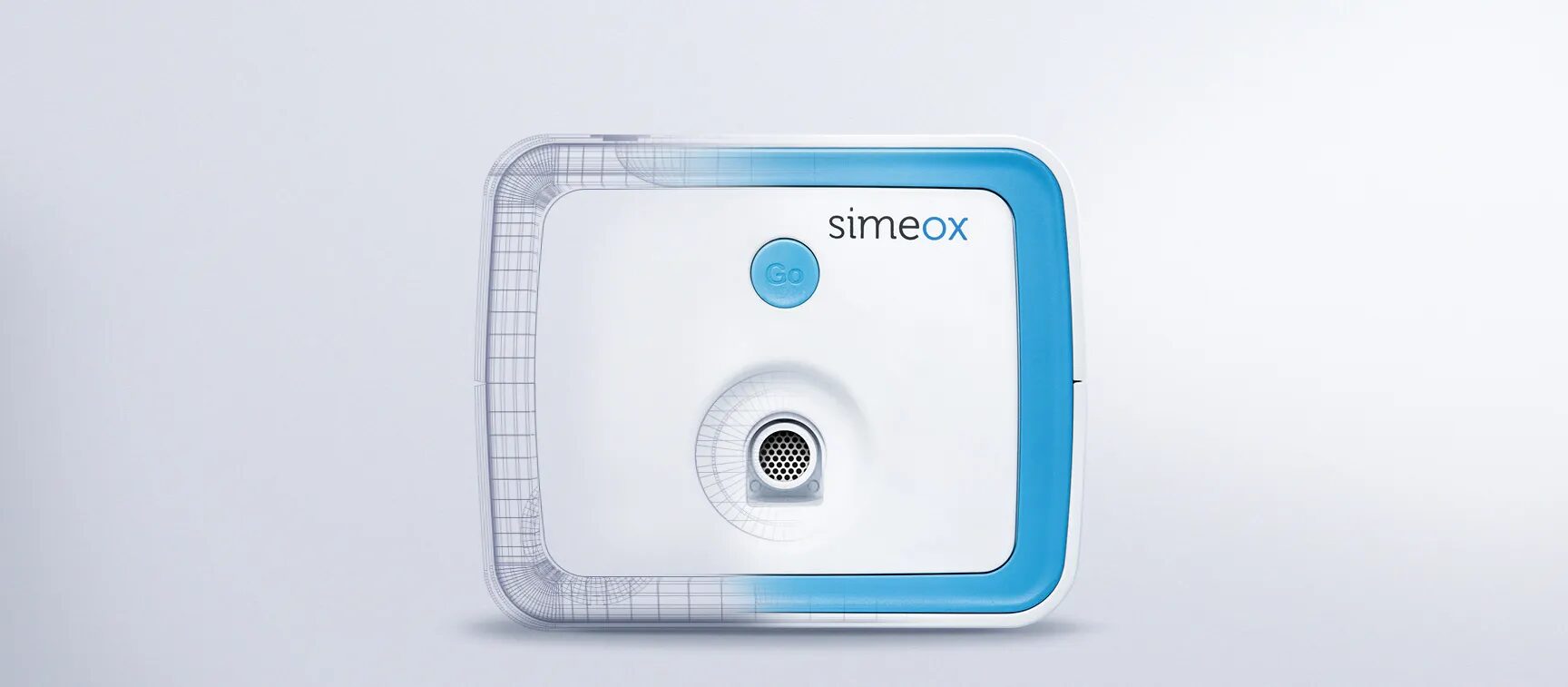
Logo, identity, industrial design, tablet app, website, films, brochures, stand, photo shoots. PhysioAssist entrusted us with its entire project around the Simeox, a bronchial decluttering device. A complete project since 2016.
PhysioAssist is a French medical startup that has designed the Simeox, a bronchial drainage device for patients suffering from chronic lung diseases. The device offers a more efficient approach to decluttering than conventional methods, with control guided by a tablet application.
PhysioAssist contacted us first for the Industrial Design du produit. En découvrant l’étendue de ce que nous pouvions faire, ils ont pris la décision de nous confier l’ensemble du projet : Logo design, graphic design of the app, communication kit, films, stands. It's a decision that we regularly see from ambitious project leaders: when you find a team you trust, you entrust them with as many aspects of the project as possible rather than multiplying the number of interlocutors.
The logo: translating physiology into a sign
Designing the identity of a medical device is a special exercise. The logo must work in a hospital context while being immediately understandable by the patient at home. It must evoke the action of the product without falling into cold medical illustration.
The concepts to be translated were precise: fluidity, respiratory cycle, mucus transformation, expectoration. We translated them into abstract shapes. Round shapes for the cycle. A layout suggesting the pulmonary alveolus. A color gradient for transformation. Elements that go out of the circle for sputum. A graphic badge that tells the story of the product without literally representing it.

Industrial design: between hospital and home
Simeox can be used in two very different environments. In a hospital environment, it is shared between several patients, handled by caregivers, stored in trolleys. At home, it is integrated into the patient's living space, and is regularly transported between home and the hospital.
The design had to respond to both contexts without looking out of place in either. We also integrated storage solutions for accessories directly into the design of the device.

The app: guide treatment, motivate the child
The tablet application is the heart of the system. It guides the treatment session, provides real-time visual feedback on the quality of the exercise, and monitors progress. In hospitals, it manages patient accounts and allows longitudinal monitoring of treatments.
We have also designed a game mode for children. Bronchial decluttering requires regularity and effort. Therapeutic adherence in young patients is a real clinical challenge. The game mode transforms the exercise into an achievable visual goal, without the child feeling like they are undergoing treatment. It is a design choice that has direct medical value.
The app has been carried out entirely in-house : ergonomie, design graphique, développement.

The charter, the brochures, the website, the films, the photos, the stand
The graphic charter has been applied to all paper documents: continuation of correspondence, Sales brochures, user manuals, technical sheets, practical cases, medical reports, patient follow-up booklets. A considerable volume of supports, all consistent with each other because they all start from the same base.
The photo shoots were also carried out in-house: casting of models, shooting, retouching. The website, the Presentation films de la technologie, et le trade fair stand ont suivi la même logique.
What appears when you have the result in front of you is rarely so at the beginning: when the same people make the photo, the brochure, the website and the film, the result is naturally coherent. When these elements are produced separately by different service providers, it takes a considerable amount of coordination work to achieve acceptable coherence.