
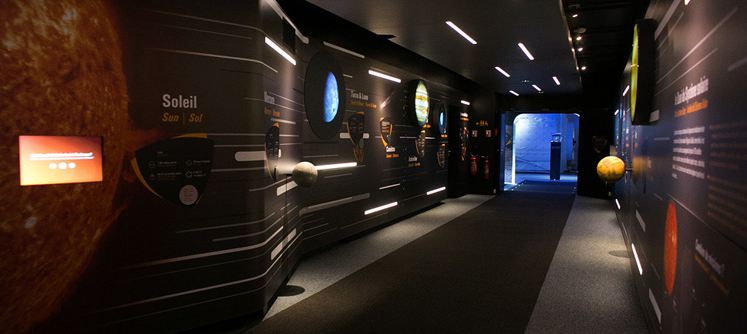
Graphic charter for permanent exhibitions, spaces from 450 to 600 m², temporary exhibitions, Cité des petits. Our collaboration with the Cité de l'espace began in 2007. It continues today.
La Cité de l’espace est un parc de culture scientifique à Toulouse consacré à l’espace et à l’astronomie. C’est l’un des sites de culture scientifique les plus fréquentés de France, avec un public varié composé de familles et de passionnés.
Our first collaboration started in 2007: a temporary exhibition called Cosmomania. Its success has opened the door to something much more structuring: the redesign of the entire graphic charter of the permanent exhibitions, intended to be applied to the 2500 m² of existing exhibition space.
The challenge of a charter for 2500 m² of heterogeneous surfaces
A graphic charter for a permanent exhibition space is not an exercise like any other. It is not applied on paper or on a screen, but on walls, signs, signage, furniture, touch screens, scenography elements. The supports are of very different sizes and natures.
The central constraint was twofold: the charter had to be strong enough to create a coherent and recognizable atmosphere across all these spaces, and flexible enough to adapt to each of them without losing its readability.
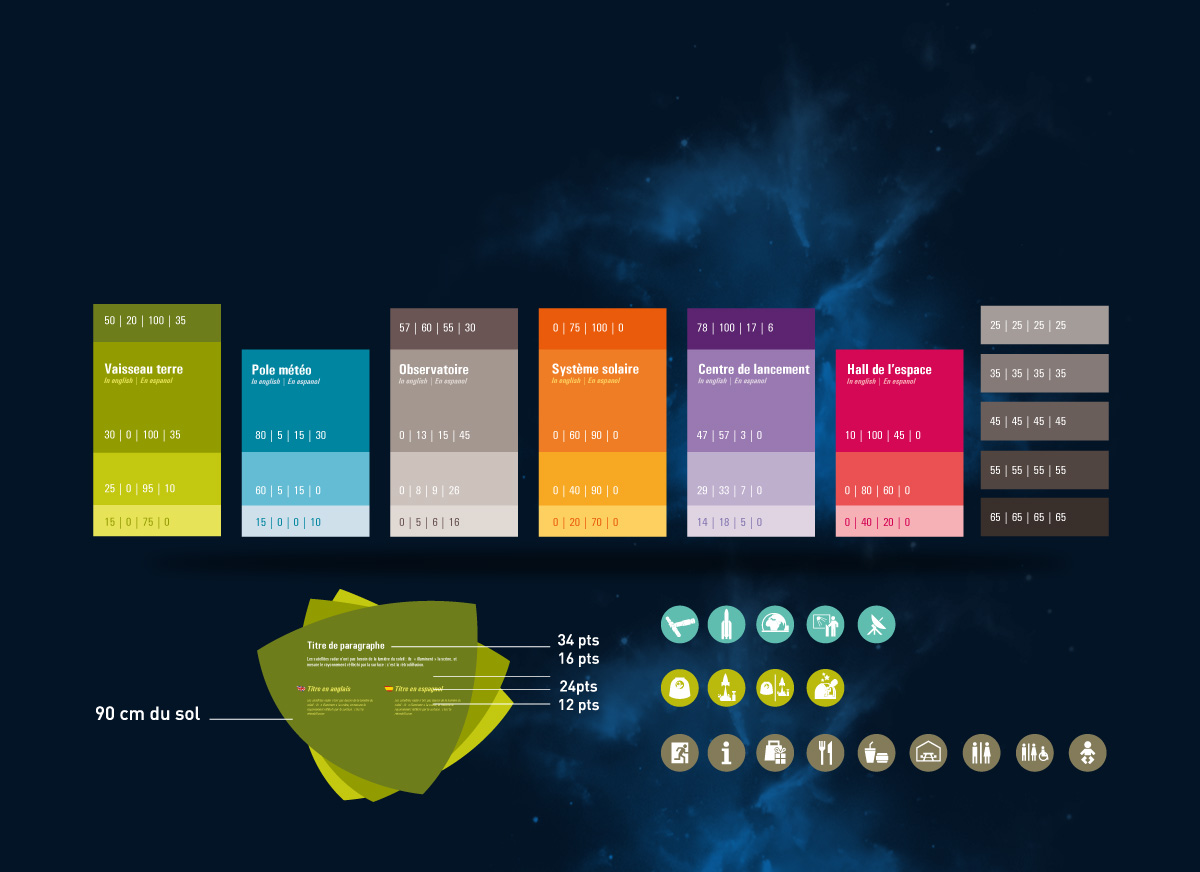
We have defined 6 shades of colour corresponding to the 6 large exhibition spaces, as well as graphic mechanisms that can be easily applied to all types of support: superimposition of layers, shades of values, organic shapes. A graphic system, not just a style.
Permanent spaces: from the solar system to the launch centre
We have created the graphics of several permanent spaces, each with its own constraints.
The Solar System Wharf, covering 450 m², takes the visitor on a journey from the Sun to the edge of the system, with spatial progression in the entrance corridor. The Ship Earth, also 450 m², presents space applications in everyday life: telecommunications, health, agriculture, environment. The Launch Center, 600 m², traces the history of space launchers from the first rockets to current programs.
Each space has its own colors to be immediately identifiable, and common graphic elements to maintain the unity of the whole. It is a balance that can only be achieved by a charter conceived as a system.
Temporary exhibitions: adaptability and itinerancy
In parallel with the permanent spaces, we have created several temporary exhibitions. Some were designed to be itinerant, presented at the Cité de l'espace and then in other places, including abroad.
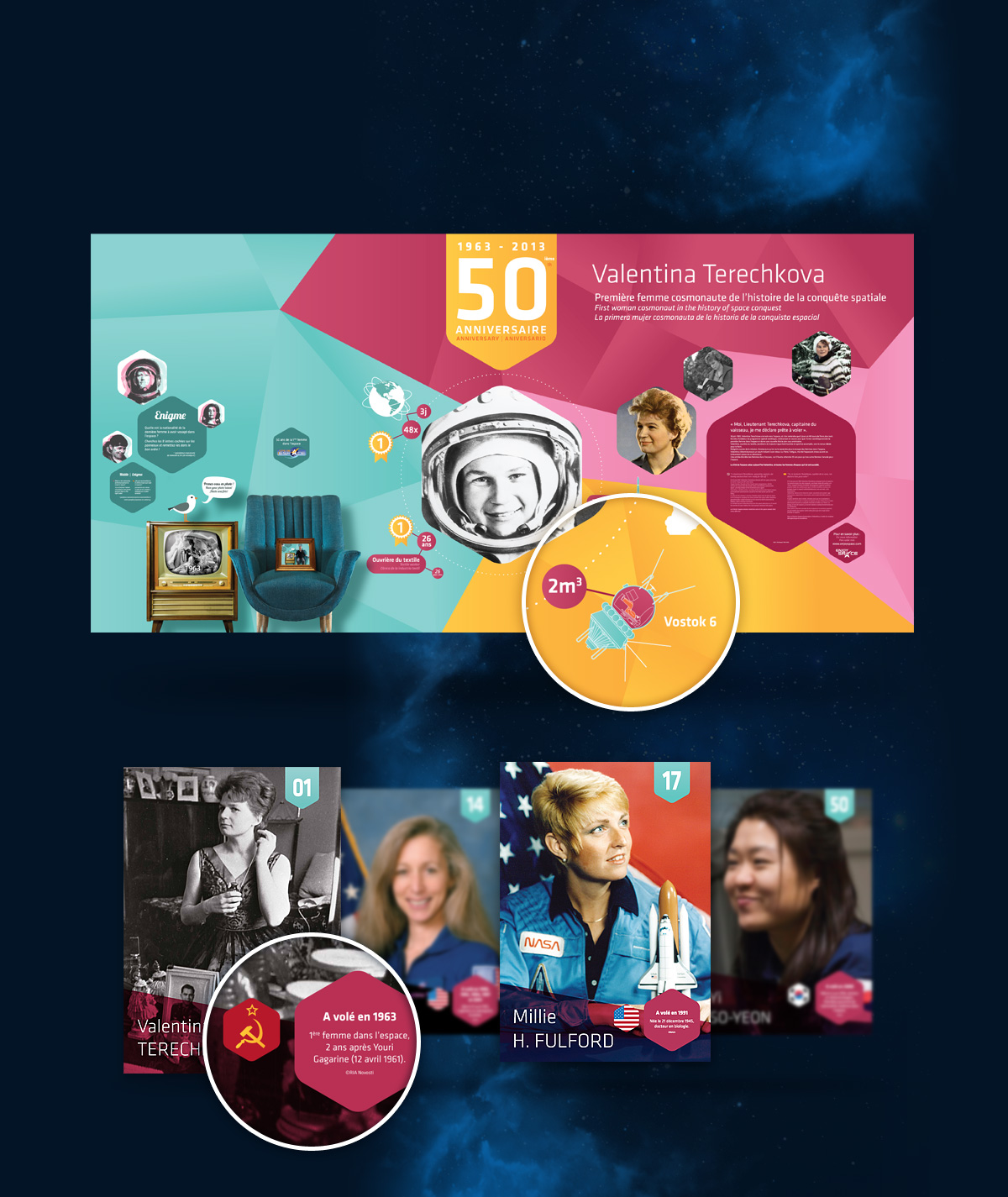
The Valentina exhibition, produced in 2013 for the fiftieth anniversary of the first woman in space, is an example of this. Explore Mars présentait l’aventure martienne et les robots explorateurs. Extreme Explorations mettait en scène les sondes Curiosity, Rosetta et Philae.
A temporary exhibition has specific technical constraints compared to a permanent exhibition. It is assembled and dismantled, transported, reinstalled in different spaces. The graphic system must integrate these logistical constraints from the design stage.
The City of the Little: when the public can't yet read
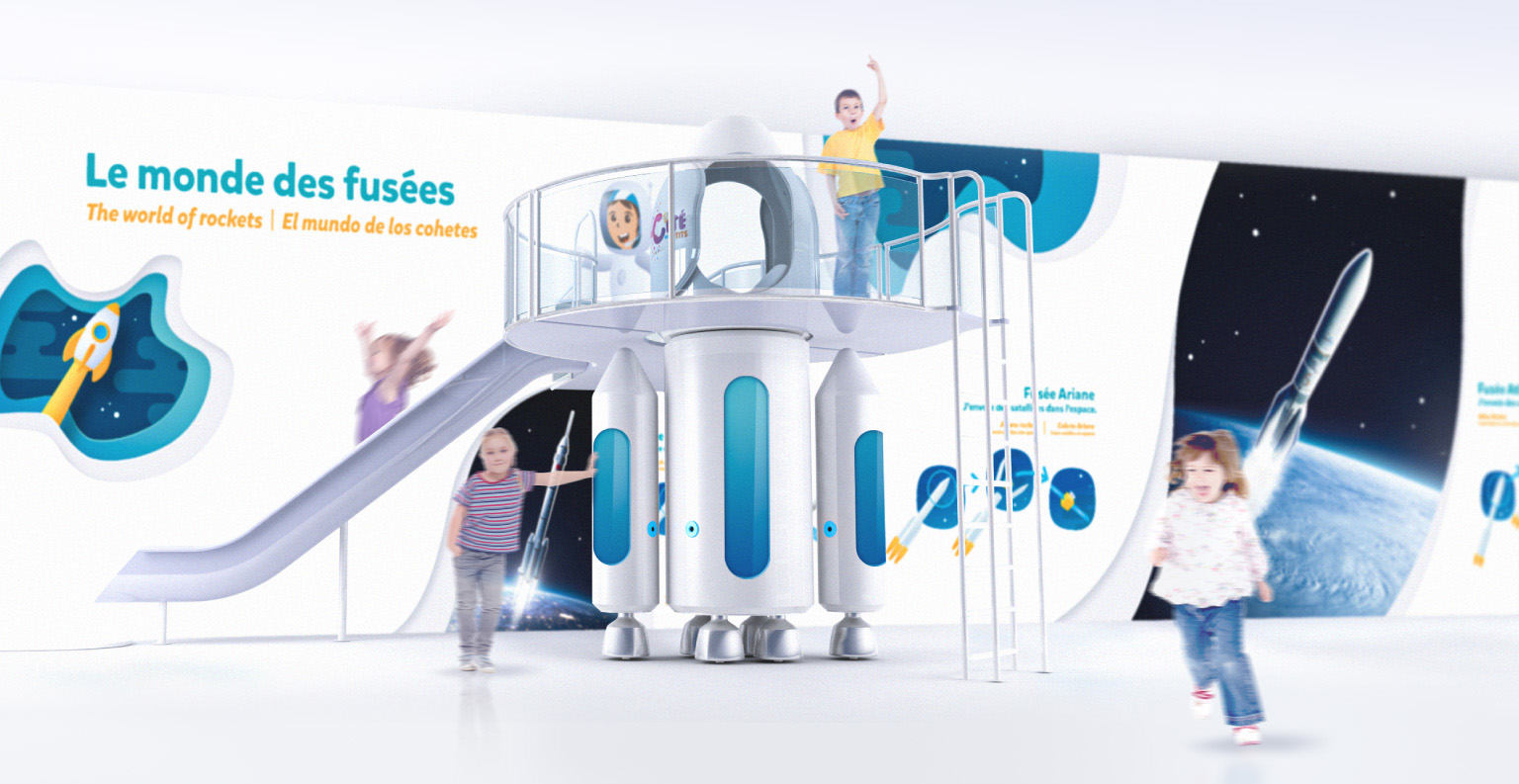
In 2020, the Cité de l'espace entrusted us with the graphic design of their New exhibition space dedicated to children de 4 à 8 ans. 350 m² sur deux niveaux : le monde des fusées au rez-de-chaussée, celui des astronautes à l’étage.
The central museographic constraint was radical: the public is essentially composed of non-readers and first-time readers. The information must therefore be conveyed visually, with little or no text. Parents have cards at their disposal to answer their children's questions, but the exhibition itself must work independently of the reading.
That changes everything. The hierarchy of information, the color codes, the size of the graphic elements, the place of the illustration in relation to the text, everything has been reconsidered since the constraint of receiving a 4-year-old child.
The palette is lively, the shapes are round, soft, evoking nebulae and stellar objects. The two spaces each have their own colors to be distinguished, and common colors to be connected. The installations are immersive and fun: a giant rocket that you fill the tanks, a space station that you enter, a rocket to assemble on your launch pad.
See the project
What this project says about exhibition graphics
Exhibition graphics is a creative field that requires a detailed understanding of the constraints of reception. A museum visitor does not read an exhibition like he reads a book. He moves, he looks, he stops or not. He may be in a hurry, distracted, tired after two hours of visiting. Graphic design must guide without imposing, inform without drowning, create an atmosphere without distracting from the content.
Our collaboration with the Cité de l'espace has been going on since 2007. It is a relationship based on trust accumulated project after project. Véronique Hallard, from the Exhibitions Department, puts it clearly:
"Museography is at the heart of our activity within the Exhibition Department, but it cannot function without two other pillars: scenography and graphic design. The work with Cubedesigners for the graphic part was in more ways than one pleasant and effective: inventiveness, responsiveness, quality of working relationships... It is for these reasons that we do not hesitate to ask Cubedesigners for new projects at the Cité de l'espace. »
Véronique Hallard, Exhibition Department of the Cité de l'espace.